Evaluation of water analysis: is its quality suitable for irrigation
Introduction
In the light of decreasing availability of water for irrigation, producers are compelled to investigate the possibility of using water sources previously not considered, i.e., boreholes or wastewater. The quality of these sources often raises concern, making producers unsure whether they can rely on them for long-term crop production or new developments.
In this document, the most common factors that determine whether water is suitable for irrigation, as well as possible mitigation options, are discussed.
Water salinity
The first quality parameter that must be considered is total dissolved solids (TDS), which is a measure of the total quantity of various inorganic salts dissolved in water.
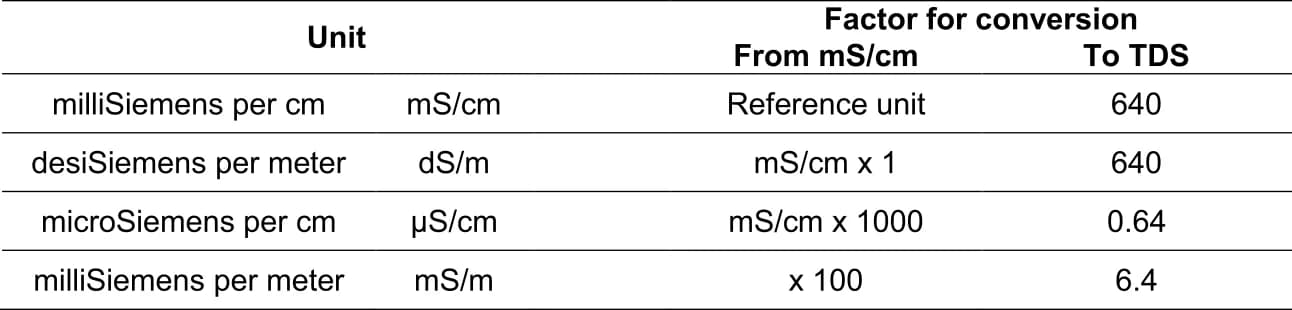
| The TDS is assessed by measuring the electrical conductivity (EC) of the water. The principle of electrical conductivity measurement is based on the fact that salts in water increase the rate at which electricity is conducted in the water – the higher the salt content, the higher the conductance. | The TDS is typically calculated mathematically by laboratories from the EC by using a factor that will differ according to the unit in which the EC is expressed. The applicable factors are provided in the table below, with the TDS being expressed as milligrams per liter (mg/L), which is equal to parts per million (ppm). |
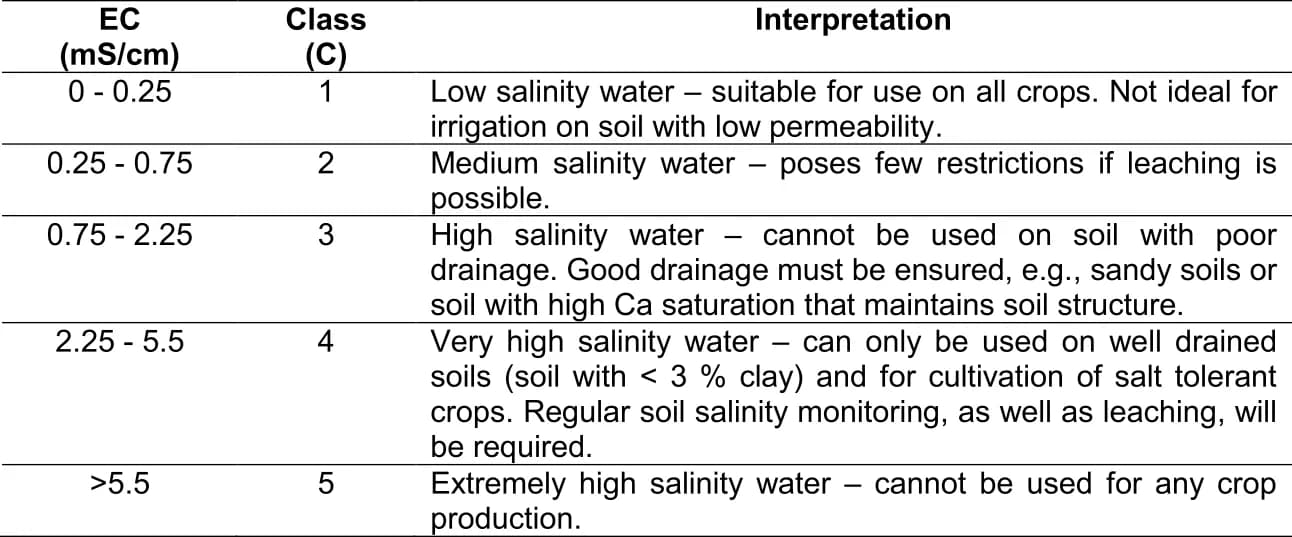
Interpretation of the total salt content of water is done, using a scale of EC values -- the higher the EC, the less suitable the water becomes for crop production. Different EC ranges are used to classify the water's quality -- the different classes that are internationally used as an indication of the water's suitability for crop production are provided in the table below. The EC, however, does not indicate the type of salts that are present in the water.
Sodium content of the water
Even though the water's total salinity places it in salinity Class C1, C2 or C3, it can still be unsuitable for irrigation due to disproportionately high sodium (Na) in the water. In addition to being a salt that can be damaging to plant tissues in extremely high concentrations, Na is harmful to soils since it displaces Ca and Mg on clay particles which results in clay dispersion and breakdown of soil structure. A decreased water infiltration and/or drainage, with an exponential increase in the rate of salinification of the soil, is the end result.
| To evaluate the risk that Na poses to the soil, the ratio of Na in relation to calcium (Ca) and magnesium (Mg) in the water is used, being expressed as a factor called the sodium adsorption ratio (SAR). | The SAR is a value that is mathematically calculated by the laboratory from the water Na, Ca, and Mg analysis results. An interpretation of the SAR values is provided in the table below. |
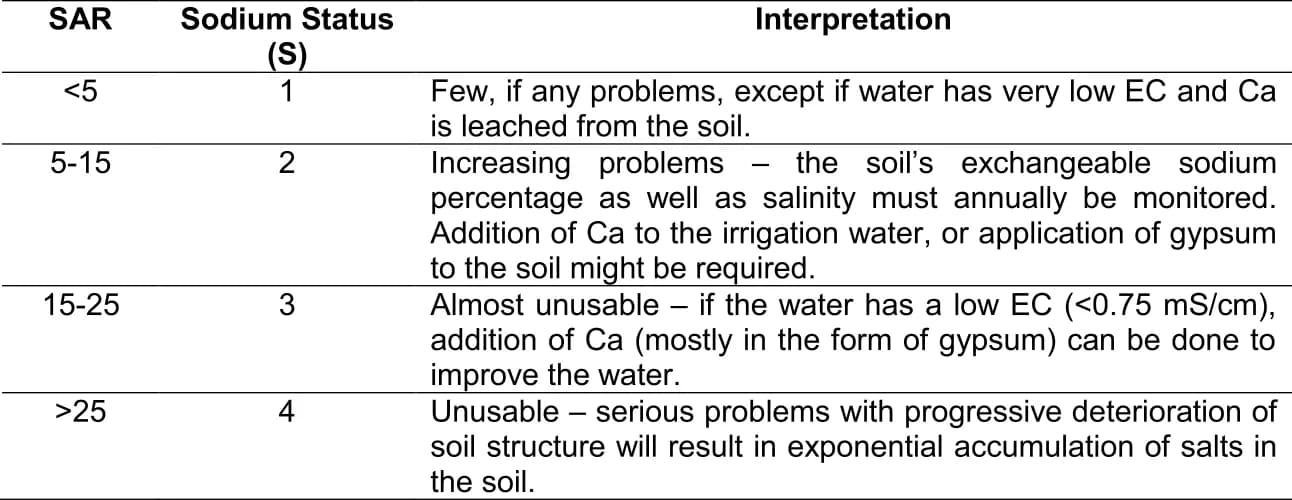
Irrigation water analysis reports will therefore often contain a so-called "irrigation class", which is expressed as "C...S...". For example, highly saline water (EC > 2.25) with a low SAR (<5) will be classified as C4S1 water. From the tables above, these classifications can therefore be interpreted.
Residual sodium carbonate index
When the pH of irrigation water exceeds 8.0, a useful alternative measure of the risk that sodium poses is the residual sodium carbonate (RSC) index. In this index, the bicarbonate (HCO3--) and carbonate (CO32-) concentrations in the water are brought into consideration. The logic being that precipitation of soil Ca and Mg with HCO32- and CO32- in the irrigation water subsequently leads to an increase in the relative proportions of sodium to the other cations in the soil solution. This situation, in turn, will increase the sodium hazard of the soil-water to a level greater than indicated by the SAR value of the irrigation water. A high RSC of irrigation water, therefore, results in an increase in the soil's exchangeable sodium percentage (ESP), with the consequent dispersion of clay, as referred to above.
On its own, high HCO3-- and/or CO32- levels in irrigation water also increases the water pH, cause clogging of irrigation systems due to calcite or lime deposition, and a whitish deposition form on leaves and fruit from the droplets of irrigation water.
In arid and semi-arid regions underground water often has a high pH and RSC. The higher the pH of the water, the higher the HCO32- and CO32- concentration will be, with a progressive shift towards CO32- as the pH increases, leading to clogging of irrigation systems. The guidelines below can be used to assess the risk of drip irrigation systems becoming blocked due to calcite/lime deposition.

| A calculation of the RSC index, to assess the risk of soil sodification should be done if the HCO32- and CO32- concentration of the water exceeds 120 mg/L and 15 mg/L respectively, and the SAR > 3. | The RSC index can be calculated from normal irrigation water analysis results, using the following formula: RSC index = ((HCO3/61)+(CO3/30))–((Ca/20)+(Mg/12)) where the concentrations are in mg/L, and the resulting RSC index value is expressed in milliequivalents per liter (meq/L). |
The following indicates the suitability of water for irrigation on account of the RSC index (meq/L):

Management and mitigation possibilities
From the above tables, it is implicit that while it is possible to use a wide variety of water quality types for irrigation, management procedures become more demanding as the water quality decreases -- the suitable range of soils and crops also become more restrictive. The possible management options to prevent the build-up of salt in the soil, and ensure long-term crop performance, are:
Soil drainage: To avoid the build-up of salts, the soil must be permeable -- permeable soil can be leached to wash out the salts. In this regard, sand is much more forgiving than heavy soil.
Leaching: Salt build-up in soil is avoided through leaching. Through regular monitoring of salt levels in the soil (measuring the soil's EC or resistance), the need for leaching (or its effectiveness when practiced) can be determined. Generally, the higher the salt level of the water, the more arid the climate, the greater the leaching requirement will be.
Irrigation frequency and duration: Irrigation scheduling has a huge impact on salt accumulation or reducing levels in the soil. Short, regular cycles will more likely result in salt build-up in the topsoil because of evaporation. On the other hand, long cycles leading to deep penetration of water, mitigate the build-up of salts in the plant root zone.
Soil and water amelioration: Irrigation water can be modified with gypsum to improve its SAR. The quantity of gypsum needed for adding to irrigation water depends upon the quality of water (the SAR and RSC) and the quantity of water required for irrigation during the growing season of the crop. The addition of gypsum increases water salinity, so this is only an option when the water's salinity is not too high, and when the soil is well-drained. Soils can also be modified using gypsum to ensure proper drainage (it helps to maintain and improve the soil's structure), but this should only be used when the soil's exchangeable sodium percentage exceeds 10% -- otherwise, the soil is actually further salinified.
In this information sheet, only three water quality parameters were discussed, i.e., total salinity, SAR, and RSC. These are regarded as the most common restricting factors. Water quality problems can also be associated with the presence of other constituents, like excessive levels of iron (Fe) or manganese (Mn), that can result in drip irrigation being blocked.
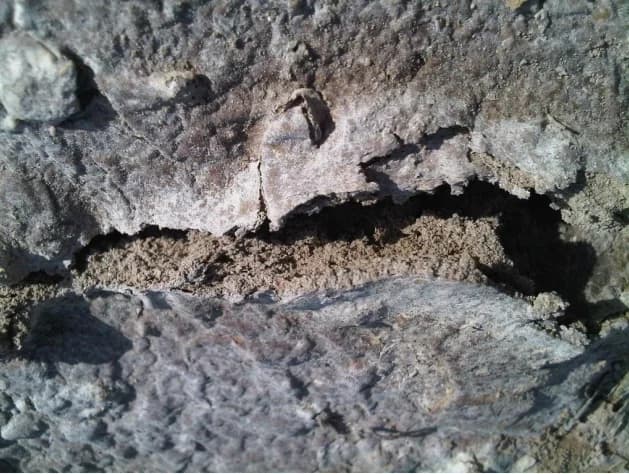
Crust formation that typically occurs on the surface of soil that is irrigated with water that has a high RSC index or an excessive SAR -- the result is excessive run-off, i.e. poor water infiltration